
Ethics in Tech Publishing: On Human Rights and the Middle East
Published on Aug 14, 2026, filed under development, politics. (Share this post, e.g., on Mastodon.)
The tech community is silent when it needs to be most vocal—that’s the impression you get when browsing the sites of tech magazines and influential developers and designers. Given just how many grave human-rights violations are being committed these days—Israel’s Gaza genocide, Israel’s ethnic cleansing of the West Bank, Israel's mass displacements in Lebanon, Israel’s and the United States’ war of choice on Iran, &c.—, that’s generally the great disappointment.
The silence has been leading to a new problem:
Tech publishers risk introducing potential war criminals to our community, associating us with them, normalizing that association, and hiding behind plausible deniability.
The New Stack can serve as an example of this lack of transparency:
The New Stack features several Israeli authors, authors who publicly document that they served in the IDF, Israeli intelligence, and/or Israeli police. Because such institutions function as unified systems where every role enables operational outcomes, active participation in them ties individuals to war crimes and human-rights violations, including the ethnic cleansing and genocide in occupied Palestine.

When you contact The New Stack about this, through their official channels, you get no response. That is, I haven’t received a response, after protesting the featuring of an IDF author—with the IDF evidently committing war crimes—and informing them how at Frontend Dogma, we stop associating with The New Stack “until [The New Stack] can comment and position [themselves] when it comes to Israeli war crimes, detailing how [they] safeguard the community in terms of making sure [they] don’t give a stage to potential war criminals.”
While The New Stack still hasn’t responded, the larger problem doesn’t go away:
The Problems With Featuring Potential War Criminals
What featuring authors with recent IDF or Israeli intelligence backgrounds suggests is that publishers accept these institutions' actions, including their possible involvement in war crimes. This is what necessitates explanation.
We have shunned (canceled) people and organizations for lesser things than featuring people who are actors in genocidal states.
What it also does is associate the community—you and me—with these crimes, by virtue of making the people who commit them part of our professional community and discourse.
If we consume media that regularly give the stage to criminals, we are eventually implicated not only in tolerating but supporting the respective crimes.
Neither the featuring nor the silence can be acceptable:
Publishers Have a Responsibility
It’s not acceptable to dodge responsibility and effectively try to normalize human-rights violations by sprinkling our community with war criminals.
Neither stance is acceptable because without taking responsibility, we all hurt ourselves: Ultimately, what is bad for another is bad for ourselves; violence against another is violence against ourselves. In this particular case, promoting people to be segregated, displaced, killed (Israel against Palestine), to put one group over another (non-Muslims over Muslims) is bad for all of us. This is responsibility in a nutshell.
Hence:
Help Protect the Community
Stand up for people under attack—Palestinians, Iranians, Lebanese, whoever they are, wherever they are—, demand accountability, and help protect the tech community by not accepting to be associated with people involved in such attacks.
Bring this into the open: Talk publicly and repeatedly about situations where we might involuntarily associate with individuals credibly linked to human-rights violations.
Disassociate from members of our community who directly or tacitly support crimes such as the ones committed by Israel.
Overall, understand that as participants in one huge community, we cannot but be political. This applies to Tech, too. While arguing for the most basic of rights that we should grant to everyone—human rights—shouldn’t even be considered “political,” ensuring these rights is basic self-interest for us as a species. That’s why in Tech, we can do a lot more than the little that’s being done, for the good of everyone.
Regarding The New Stack, let’s see if and what they will respond. So far it doesn’t look like it, but perhaps there’s some vetting going on and some official position that will explain everything in a light that can be acceptable to you, to me, to Frontend Dogma, and our community.
About Me
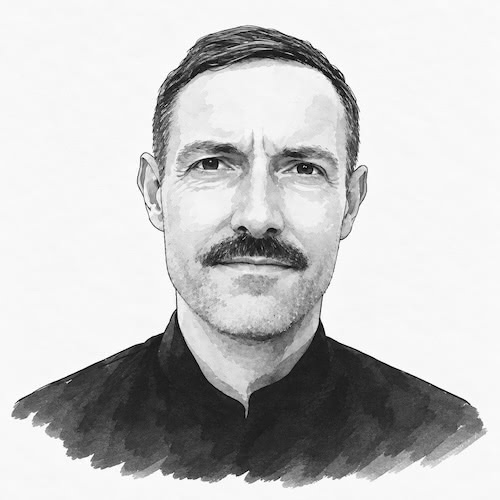
I’m Jens (long: Jens Oliver Meiert), and I’m an engineering lead, guerrilla philosopher, and indie publisher. I’ve worked as a technical lead and engineering manager at various companies (e.g., Google); I’m an active web and tool developer (code optimization, digital defense), a contributor to web standards (like HTML, CSS, WCAG), and a book author (O’Reilly, Frontend Dogma).
I love trying things—in web development and engineering management, but also in politics and philosophy, where I hold to one idea in particular: that we can only be well if we take good care of everyone. Here on meiert.com I talk about some of my perspectives and experiences. (Interpret charitably but be critical—and share feedback and advice that makes my work better.)