
2026: 2 of the Global Top 200 Websites Use Valid HTML
Published on Sep 10, 2026, filed under development, html, conformance. (Share this post, e.g., on Mastodon.)
It’s time for the annual analysis of how much of the HTML code in the field is error-free and valid. The short version: 1% of the most-frequented sites on this planet uses valid HTML—and 99% don’t.
The usual disclaimer: The following data gives an impression of precision that is greater than warranted. The point of this annual analysis is to check on full HTML conformance—absence of markup errors—on home pages. That is, the specific error counts don’t matter for the purpose of telling conformance, and pages other than home pages aren’t being checked. I’m providing the data for further study and for comparability to previous years.
Contents
Analysis
Like every year since 2021 (cf. 2022, 2023, 2024, 2025) I used the the Ahrefs Top 1,000 most-visited websites to check the home pages of the first 200 websites on HTML conformance. *
For this purpose, I took all the respective URLs, prepared HTML validation URLs, validated each page, and documented the error counts of the 200 tests in a spreadsheet: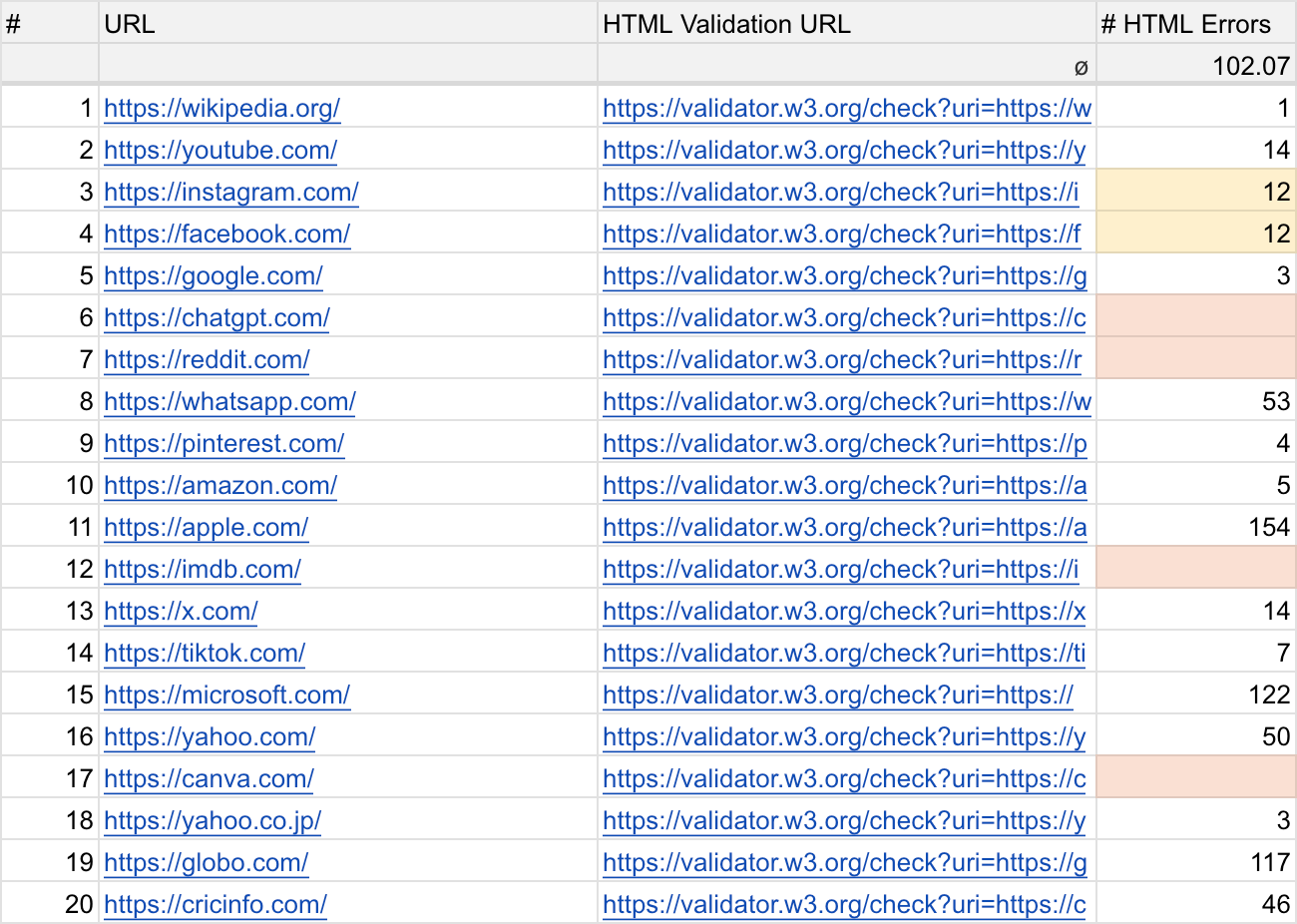
HTML Conformance in 2026
Slightly improved: 2 of the 200 home pages have no HTML conformance errors. This is up from 0 home pages that were valid in 2025.
What are these two home pages? adobe.com and gov.uk! (I reached out to ask if their web teams would like to comment in a brief interview over on Frontend Dogma. If so, I’ll add links here as well.)
Slightly improved: 7 home pages (up from 6 in 2025) have only 1 validation error.
Improved: 51 additional home pages (up from 37) have a single-digit number of validation errors.
Slightly improved: 62 home pages (down from 63) have more than 100 errors (and may or may not resemble HTML).
Slightly improved: The average number of HTML errors is 102.07 (down from 110.45).
Improved: The median is 27 errors (down from 55.5 last year).
HTML Conformance Over Time
We need to test more websites for this to be significant, but here’s how error counts developed over the years:
| Year | Average number of HTML errors on home page | Home pages without errors |
|---|---|---|
| 2026 | 102.07 ↘ | 1% ↗ |
| 2025 | 110.45 ↗ | 0% ↘ |
| 2024 | 99.34 ↘ | 0.5% ↗ |
| 2023 | 132.14 ↗ | 0% → |
| 2022 | 125.63 → | 0% ↘ |
| 2021 | 125.22 | 2% |
Notes
During the analysis, the W3C validator has frequently been throwing—I had to test 270 home pages to get to 200 results. As in other years, I didn’t pay much attention to whether pages that couldn’t be tested were actively blocking the validator—but I suspect that this is overeager CDN or other configuration rather than intentional blocking.
As mentioned in the intro, the analysis checks on whether the most popular websites use valid HTML. For that purpose, it’s interesting but not relevant how many issues there are, or if a page to be tested doesn’t happen to be the main page. The logic is this: If any page on a website, like the home page, has validation errors, the site cannot be valid anymore. †
Interpretation
First, what do you think? Please share your observations on Mastodon, Bluesky, or LinkedIn!
Personally, I would only call out two things:
We’re still in an incredibly bad shape. All these websites are managed by well-trained, highly paid developers—and yet they ship code with errors, errors that are both easy to catch and easy to fix.
However, the trends this year are all vaguely positive. While the data are not significant enough to confirm a larger shift, this is the first time that we observe improvements on all metrics.
As things stand, professional web development is still in a state of crisis, not using conformance-checking as a tool to deliver professional, error-free work and to strengthen the craft and the profession itself.
If 2027 continues the positive development, however, maybe we will start to observe a more sustained change in how the field views the craft and its responsibility to deliver at least basic quality—conformant, valid, error-free HTML.
If you want to know why and how to write valid HTML, check out my link guide on minimal and valid HTML. Also, stay in touch, because on this website and in my books, I write a lot about the craft of HTML. See you around.
* I do so faithfully, that is, I don’t check and question Ahrefs’ methodology. There have been concerns about some of these sites in the past—like, that some seemed spammy—, but I’m leaving that issue to Ahrefs. This is not to say that you shouldn’t be critical.
† Of course, this doesn’t work the other way around: If a home page has no errors, it doesn’t mean the entire website is valid—other pages could still contain errors.
About Me

I’m Jens (long: Jens Oliver Meiert), and I’m an engineering lead, guerrilla philosopher, and indie publisher. I’ve worked as a technical lead and engineering manager at various companies (e.g., Google); I’m an active web and tool developer (code optimization, digital defense), a contributor to web standards (like HTML, CSS, WCAG), and a book author (O’Reilly, Frontend Dogma).
I love trying things—in web development and engineering management, but also in politics and philosophy, where I hold to one idea in particular: that we can only be well if we take good care of everyone. Here on meiert.com I talk about some of my perspectives and experiences. (Interpret charitably but be critical—and share feedback and advice that makes my work better.)