
2025
Published on Jan 1, 2026, filed under misc. (Share this post, e.g. on Mastodon or on Bluesky.)
Goodbye 2025, happy 2026!
Following an unchallenged tradition, here’s my professional and personal retrospective of the last year!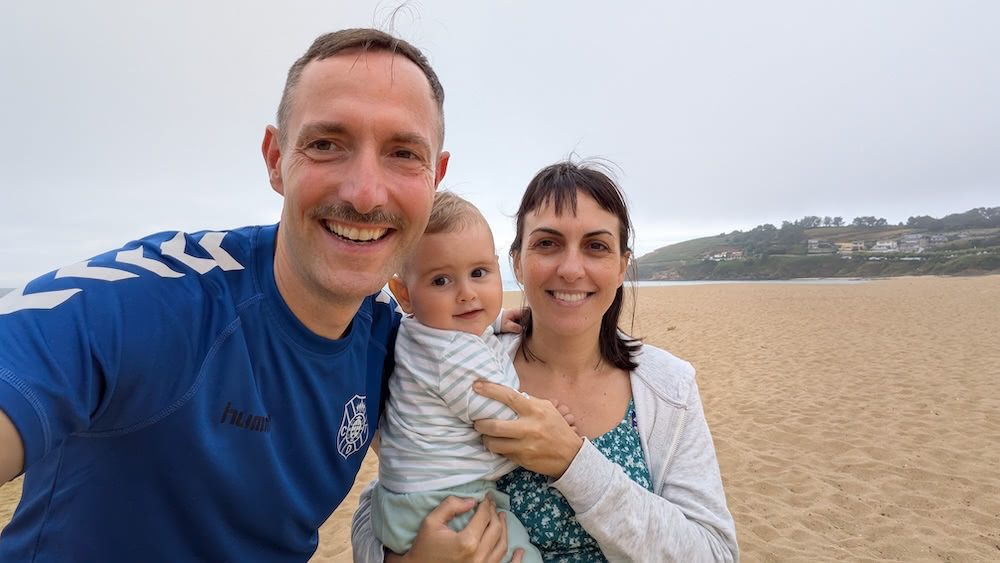
Professionally
2025 was an extraordinarily productive year. I won’t manage to share all of the details, given that the work included a few table stakes initiatives around my own projects, but one thing I can say early on: AI has been a key to my own enhanced engineering productivity, and I learned a lot during the year that improved my use of AI even further. I won’t say much more here, but I’ve written about AI before and will write about it more.
For professional highlights, one was my joining and leaving PandaDoc. I had been quite excited about joining in April, as a Senior Engineering Manager taking on two teams in the Customer Value domain. About five months later, I decided to leave after a key partner for one of my teams turned out not to be vested in mutual success (this is diplomatic), and when after working on several solutions, it turned out there was no way forward that wouldn’t have misspent more of my time and energy—time and energy I wanted to spend on PandaDoc’s and the teams’ growth. Overall, I’ve never experienced anything like this, but it’s not my style to elaborate any more here.
In July, I took on stewardship for HTML Minifier, in form of a fork, HTML Minifier Next. What started out as an effort just to keep the HTML Minifier family afloat after both HTML Minifier and HTML Minifier Terser had been unmaintained for a few years, turned out to become a project I’ve pushed hard over the last few months, leading to a maintained, more stable, more capable, and significantly faster minifier. Catch up and stay tuned!
(On this note, I’m likewise quite happy having been able to help the W3C validator project, too. HTML validators and minifiers are critical web tooling, and I’m really excited about being able to contribute on both fronts.)
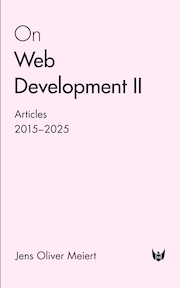
In November and after 10 years, I published the next edition of On Web Development, On Web Development II. This ebook series is a by-product of my blog here, but I believe a nice one—it makes it easier to consume and support my technical work, and like any such work serves as a testament how the field and the people in it change.
Statistics
- Code changes made: 14,585 → (GitHub-only and including private repos)
- Articles published: 88 ↗
- Articles discarded: 12 →
- Books read (largely non-fiction): 44 ↓
- Books published: 2 →
Personally
Personally, April brought the first highlights, just before I started at PandaDoc:
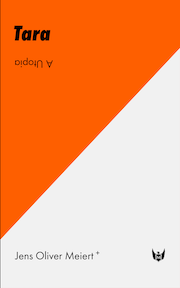
First, I released Tara, a utopia I just had to try to produce using AI. (The utopia I really hope to write myself I started and prepared, but it may take a few more years to be available.) Now yes, “AI,” and yes, the raw manuscript was… a piece of work, but I believe that many rounds of editing still make Tara tell an interesting story. I price fairly, so why not check it out and share your take with me?
Also in April, I released the new version of this website, meiert.com. I’ll keep this short, but this wasn’t only a lot of work, as you can imagine, but it was also crucial work to be done, “table stakes” as mentioned, to streamline my entire tech stack and publishing flow. (It was the needed piece for me to be fast preparing On Web Development II.) Fun fact: I wanted to do this for a long time—you can tell when you consider that the design for the new site goes back to a prototype from 2009.
July and August meant no highlights per se, but a change quite literally in policy: Disillusioned with my home country’s complicity in the Israeli genocide on the Palestinians (what have we learned?), I’ve significantly increased support for Palestinians as well as efforts to enforce international law, and advocacy against colonialism and genocides. You can read up on some of my work, though I ask—urge—you to take more action as well. You’re probably already active and have some more ideas, but check out what you could do against any country like not-so-fictitious Genocidistan.
In December, I—we—purchased a new home, even closer to the sea. There’s work to do there, and we’re yet to move, so expect more on this in the review for 2026!
Statistics
- Diapers changed: not even kidding anymore… certainly north of 500 ↑
- Films watched: 1 ↓
- Songs (re)discovered: 59 (Q1, Q2, Q3, Q4)
- New specialty coffees tasted (at home): 44 →
A Note
2025, to me, stands for disappointment and disillusion. Israel’s colonial enterprise and their genocide on the Palestinians opened my eyes not just how consistently reckless and brutal Israelis are (and anyone supporting and backing Israel’s crimes), but also in what miserable shape we are with respect to fighting and ending colonialism, racism, violence, and contempt for international law. What’s worse, that’s just the summit of the human cruelties mountain, because if you think about all the -isms common in our world, if you think about that we allow people to be exploited and murdered, that we plunder and strangle our own habitat, you end up so depressed that you, too, wonder what you’re doing on this planet.
There’s no known species as primitive as ours.
We do not need to throw our hands up in despair, however: Our problem is not that people aren’t that smart (they could be smarter—we need better, free education—but they’re smarter than we often think), it’s that they—we—are too afraid.
Being more courageous isn’t a switch though, but a dial—and it’s not the only one we have: That it’s a dial means we can slowly, depending on our tolerance for risk, turn it up. That it’s not the only dial means we want to be smart about it:
The world views of Nazis, Revisionist Zionists, Republicans, homophobes and xenophobes, misogynists and speciesists, of people who do not at all understand that our key literally to heaven on earth lies in making sure everyone, without exception, is taken care of may feel domineering and overwhelming by now, but it’s exactly their hatred that will ultimately backfire.
Accordingly, what we observe in the world today looks grim, but all of it will ultimately grow and strengthen everyone who understands this basic idea—that our own happiness depends on everyone else’s happiness. Let’s just hope we discover this in time before the next catastrophe we’re seeking.
An Outlook
Going back to my personal retrospective, what is 2026 to bring? Professionally and personally, I will invest in four areas:
- Renovate and move into our new home
- Release several new books, starting with The Web Development Glossary 4K and Upgrade Your HTML VI
- Move into video to share and discuss more of both my technical and non-technical work
- Develop and ship a few micro-products
But as always, 2026 is to mean what every year means: An opportunity to decide who we are.
_ These are some impressions of my version of 2025. How was the year for you? What’s up for 2026? All the best!
About Me

I’m Jens (long: Jens Oliver Meiert), and I’m an engineering lead, guerrilla philosopher, and indie publisher. I’ve worked as a technical lead and engineering manager for companies you use every day (like Google) and companies you’ve never heard of, I’m an occasional contributor to web standards (like HTML, CSS, WCAG), and I write and review books for O’Reilly and Frontend Dogma.
I love trying things, not only in web development and engineering management, but also with respect to politics and philosophy. Here on meiert.com I talk about some of my experiences and perspectives. (Please share feedback: Interpret charitably, but do be critical.)