
The Trolley Problem but Difficult?
Published on Aug 30, 2026, filed under philosophy. (Share this post, e.g., on Mastodon.)
You probably know Philippa Foot’s famous trolley problem:
A runaway trolley is barreling down the tracks toward five people who are tied to the track and cannot move. You happen to be standing next to a lever that, if pulled, will divert the trolley onto a side track. However, there is one person tied to that side track who would then be killed instead. Do you pull the lever?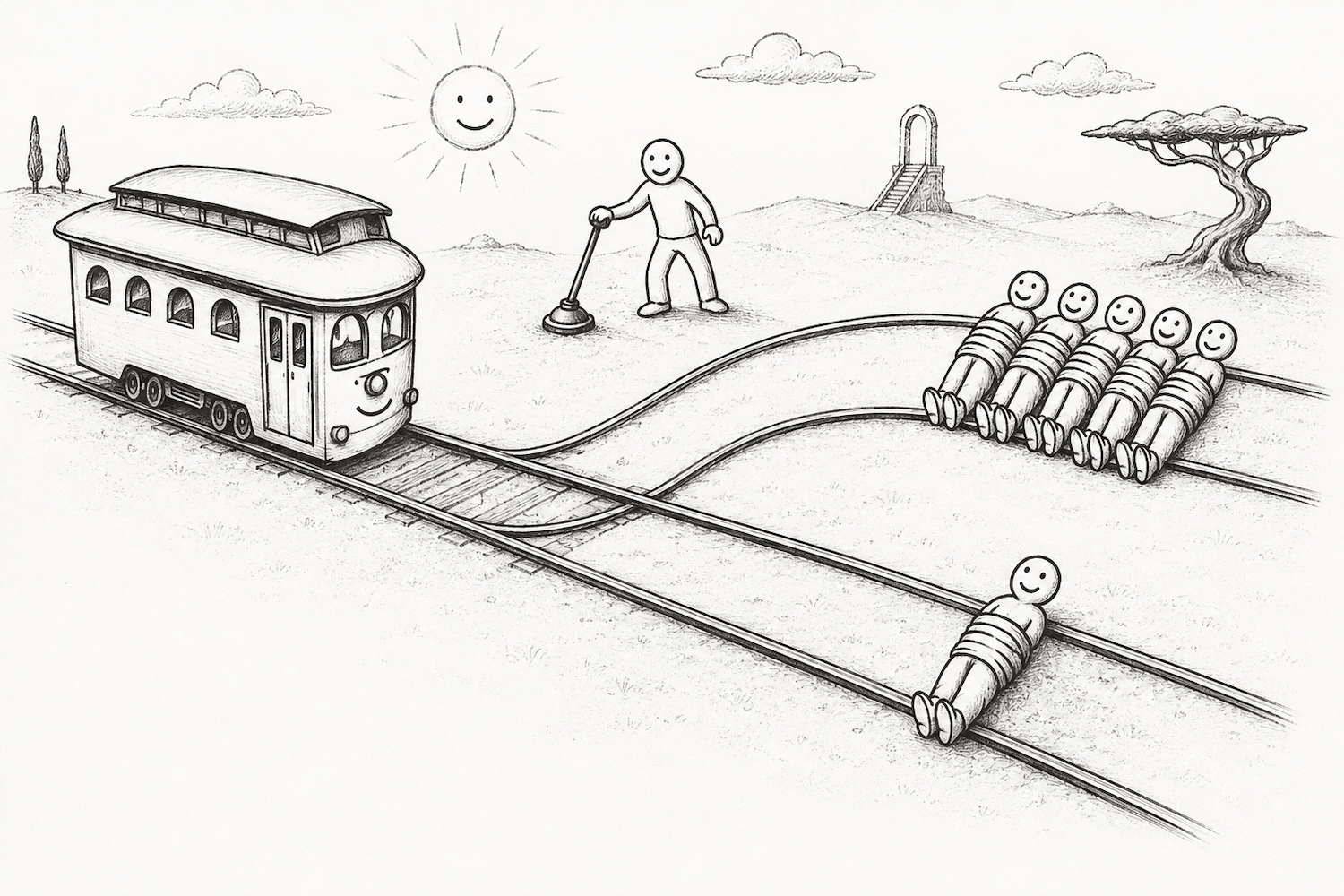
This is a dilemma for it offers no good choices.
Now put your philosophy glasses on and consider the trolley problem under the following conditions:
What if Everyone Decides When They Die?
What if, subconsciously if you will, everyone decides about their death and agrees with their dying?
Is the trolley problem a problem if there cannot be a case in which the person(s) to die have not decided to die?
What if There Is No Death?
What if there is no death in the first place, if we, according to some schools of thought, only change form?
Is the trolley problem a problem—or what type of problem is the trolley problem—if there is no actual end to the existence of anyone involved?
What if You Are the One Pulling the Lever and Also Everyone on the Tracks?
What if there is no separation, and everyone involved in the trolley problem is part of the same larger entity?
Is the trolley problem a problem if it’s exercised by one being, on itself?
What if? Asking and exploring questions like these is what I enjoy about philosophy. My own take? Yes, I believe all these conditions are true. The trolley problem is a dilemma making specific assumptions, and it falls flat if some of these assumptions, notably around our ideas around death, don’t hold. Then, the trolley problem somewhat ceases to be… a problem.
About Me

I’m Jens (long: Jens Oliver Meiert), and I’m an engineering lead, guerrilla philosopher, and indie publisher. I’ve worked as a technical lead and engineering manager at various companies (e.g., Google); I’m an active web and tool developer (code optimization, digital defense), a contributor to web standards (like HTML, CSS, WCAG), and a book author (O’Reilly, Frontend Dogma).
I love trying things—in web development and engineering management, but also in politics and philosophy, where I hold to one idea in particular: that we can only be well if we take good care of everyone. Here on meiert.com I talk about some of my perspectives and experiences. (Interpret charitably but be critical—and share feedback and advice that makes my work better.)