
Philosophy
Western Hypocrisy Is Western Supremacism
An argument against double standards, separation, and a hierarchy of worth.
#89 · · politics
On the Twisted Logic of Labeling Criticism of Israel as “Anti-Semitism”
When defending human rights is framed as prejudice, the public conscience is backed into a corner.
#88 · · politics
Slavery
Chances are, we’re all enslaved, and accept our lot rather than reimagine how we could all live together on this planet.
A Decent Person
Can we be, can we raise decent people if we cannot be against wars and genocides, if our governments prosecute being against wars and genocides?
#86 · · politics
AI Will Never Be Ethical or Safe
On the importance, unknowability, and unignorability of context and intent.
#85 · · ai
The Violence Imperative
Violence is too severe to tolerate.
On Living in a World That Suffers and Burns
What helps us deal with this spiraling mess out there is understanding something about our model of the world, making conscious decisions about who we are, and being smart about how we bring about change.
#83 · · politics
A Secret
10 years ago—
#82 · · politics
Psychology, Philosophy
On the importance of our views of the world.
#81 · · misc
The Economy Is Important Because
A thesis.
#80 · · politics
On Trust
How trust is active, not passive, how it’s connected with truth, and how we’re in trouble.
#79 · · misc
Ethics: On the Suspicion That Utilitarianism Is Failing Us
Utilitarianism isn’t inclusive. Focusing on responsibility, as one option, helps us better connect with everyone around us.
#78 · · politics
The Problems With Being an Influencer With Millions of Followers
When you have 99 problems—and you’re not unhappy that being an influencer isn’t one of them.
#77 · · misc
Prisoner’s Dilemma
On “tit for tat” with about 10% more forgiveness.
#76 · · politics
On Ethics in Web Development (With a Brief Overview of Ethical Theories)
When we read and talk about ethics in technology, it’s rare that we’re explicit about the school(s) of thought we’re following. Surprisingly, this lack of clarity often works—but it’s relevant, interesting, and useful to be more clear about our ethical theories.
#75 · · development
On Deciding Who We Are
When a country cannot agree to “advancing a comprehensive, just, and lasting peace in Ukraine” (or other countries).
On Making Sure Everyone Is Taken Care Of
For our own sake.
The Donkey and the Rabbit
A rabbit goes for her daily run. This day, she decides to try a new route. At an intersection she meets a donkey. When the donkey is about to eat a nail—
#72 · · misc
Private Property
A quote, from Daniel Loick, that isn’t new, that isn’t all.
What I Learned About That Difficult Childhood
On a changing—and perhaps transcending—perspective on pain.
#70 · · misc
Everyone Can Set You Up for Failure, Not Everyone Sets You Up for Success
On a conscious choice that we can make, and that we best make sure others make.
#69 · · management
Not Knowable
Casual appreciation about our dealing with knowledge.
#68 ·
The Assessment Paradox
For any individual or group we may think that it can assess itself best because it knows itself best. Yet this is not reliable. We may then think it’s other individuals or groups interacting with that first individual or group who may be able to assess it. This is not so, either.
#67 · · management
Highlights From “On Liberty” (John Stuart Mill)
“The fatal tendency of mankind to leave off thinking about a thing when it is no longer doubtful, is the cause of half their errors. A contemporary author has well spoken of “the deep slumber of a decided opinion.‘”
#66 · · politics
Exploitation
What and who is easiest to take advantage of and exploit, how is that being justified, and what can be done about it? On one piece of the puzzle what the fewest things are that need changing, to change everything.
#65 · · politics
Why Online Communication Is So Not-Great
Why is online communication so, meh? An approach that considers context, training, and worldviews, for a much more complicated topic.
#64 · · misc
Existence and Experience
How can something-exists experience itself?
#63 ·
The Good Things About All the Problems
On things we cannot meaningfully discuss, and the sequel to The Problems With All the Good Things that may never be.
#62 ·
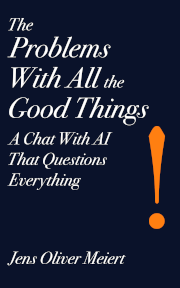
The Problems With All the Good Things
When good is considered unproblematic, and everything can be shown to be problematic, then—partner up with AI.
#61 · · books
Give
On one-things and lack.
Highlights From “The Social Contract” (Jean-Jacques Rousseau)
“The strongest is never strong enough to be always the master, unless he transforms strength into right, and obedience into duty.”
#59 · · politics
Highlights From “The Protestant Ethic and the Spirit of Capitalism” (Max Weber)
“The modern rational organization of the capitalistic enterprise would not have been possible without two other important factors in its development: the separation of business from the household, which completely dominates modern economic life, and closely connected with it, rational book-keeping.”
#58 · · politics
“The One With the Biggest Hammer Wins”
On a game we could stop playing.
3 Books for Working With Reality
With or without The Complete Conversations With God, The Nature of Personal Reality, and Loving What Is?
#56 ·
The Choice to F Up
On the things we are doing and not doing, how these things are not and cannot be accidents, and how it all revolves around choice.
Highlights From “An Introduction to Psychology” (Wilhelm Wundt)
“There cannot be the least contradiction in the idea that physical and psychical phenomena follow different laws, as long as these laws are not irreconcilable with the actual unity of the psycho-physical individual.”
#54 · · misc
Counter the Happiness Assumption
It may be rather clear that life is not all about being happy.
#53 ·
Highlights From “Free Thought and Official Propaganda” (Bertrand Russell)
“Our system of education turns young people out of the schools able to read, but for the most part unable to weigh evidence or to form an independent opinion.”
#52 · · politics
What Happened on Google+, the Philosophy Archives
Google+ is shutting down, pulling everything with it. I’ve used Google+. And although I’ve changed and would put a few things differently now, I decided to archive a few of the somewhat philosophical Google+ posts.
#51 · · misc
Survival of the Primitive
Is ours a highly evolved culture?
#50 · · politics
Highlights From “Flatland” (Edwin Abbott Abbott)
“Yet I exist in the hope that these memoirs, in some manner, I know not how, may find their way to the minds of humanity in Some Dimension, and may stir up a race of rebels who shall refuse to be confined to limited Dimensionality.”
#49 · · design
The One Thing We May Really Want to Research
My back-burner philosophical work revolves around one idea: that what creates and makes for our reality, in quite practical terms, is what we believe. That idea is profound and requires more: research.
#48 ·
Highlights From “The Communist Manifesto” (Karl Marx and Friedrich Engels)
“This organisation of the proletarians into a class, and consequently into a political party, is continually being upset again by the competition between the workers themselves.”
#47 · · politics
What We Know
On some days, if you asked me about what we know, with absolute certainty, I’d respond with “only that something exists.” And if you asked me what that meant, then I’d add “to appreciate and work with what exists.”
#46 ·
The Scientific Irony
There’s no proof that life has meaning; therefore, life is meaningless. Wait, what?
#45 ·
Freedom = ƒ(Money)?
No, this question is not new. However it’s one I want to ponder with you because it much seems like something truly terrible has happened over the centuries.
#44 · · politics
Why It Would Be Bad if Jesus Was Here
Arguing is something we have to learn. I observed this particularly in recent years when I started studying philosophy and went through courses for logic and argumentation theory. These courses…
#43 ·
In Defense of Bad Luck
There seems to be something to luck, and bad luck.
#42 ·
On Being a Philosopher
I call myself a philosopher even though some people would disagree with me being one. Why would I be a philosopher? What makes a philosopher?
#41 ·
Highlights From Dewey’s “How We Think”
“The very importance of thought for life makes necessary its control by education because of its natural tendency to go astray, and because social influences exist that tend to form habits of thought leading to inadequate and erroneous beliefs.”
#40 · · politics