
Web Development (7)
70% Repetition in Style Sheets: Data on How We Fail at CSS Optimization
Looking at data for some of the most popular websites, we repeat ourselves too much in CSS; using declarations just once is often one solid avenue to avoid repetition; together, we need to put more focus on style sheet optimization.
#171 · · css, maintainability, optimization
The Great Web Maintainability Survey
The maintenance and economics of websites is a much-neglected topic in the web development community. Here are three questions for developers, to gather practices as well as resources.
#170 · · maintainability
Principles of Web Development
Web development, at more than 20 years of age, is becoming an increasingly mature profession. Web development is yet also subject to constant change, and the field produces more of that change, out of itself. More technological standards…
#169 · · quality, maintainability
HTML Statistics: 5 Take-Aways
A few quick comments on Catalin Rosu’s interesting follow-up analysis of his sampling of eight million websites. Some practices are wonderful to note, others have been commented on, yet one or the other point drowned.
#168 · · html
On Quality and Logistics
Clearly, quality requires quality thinking. But then it requires a lot more, like definitions, criteria, tools, planning, enforcement, &c. pp. And it relies on some organizational foundation.
#167 · · quality
Apocryphal Apostrophes
Oh, typography. How have you been.
#166 · · design
CSS Shorthand Syntax Considered Important
CSS shorthands are no anti-pattern, just as little as universal selectors, just as little as !important, and just as little as no-js would not be one. Now we learn that shorthands were an anti-pattern. No, they’re not. Yes, they are! No they’re not.
#165 · · css
Why I Don’t Use CSS Preprocessors
A tribute to Roger Johansson as well as the craft of web development.
#164 · · css
“Don’t Believe Everything You See, Sophie”
#163 · · interviews, philosophy
About the Mindset for Quality
In my view, quality starts with quality thinking. Quality thinking is broad, but it quickly leads to a quality mindset. This mindset, now, I’ve long regarded as critical…
#162 · · quality
Stop Using the Old “Clearfix”
I had thought the old method of clearing through .clearfix:after { clear: both; content: ''; } long dead, but then I spotted it quite alive, even being taught to developers.
#161 · · css

The Little Book of Website Quality Control
The hallmark of a professional is not the pursuit of activity, but the expertly pursuit thereof. What’s worth doing is worth doing well; and what’s done well exemplifies quality. A professional website is no exception, and there are criteria and tools to help.
Accelerated Mobile Pages, a Critical View
Last year Google introduced AMP and the Accelerated Mobile Pages Project. Independent of suggesting tech paternalism when AMP gets treated preferably in search rankings, I’ve been concerned about what the AMP spec entails exactly.
#159 ·
WordPress Themes and Web Development
Like everyone on this planet I work with WordPress. Just setting up a new project I ended up using and building on one of their default themes, Twenty Sixteen. Had I better not?
#158 ·
The Anatomy of a Coding Guideline
Coding guidelines produce consistency, help (code) usability, collaboration, and maintainability, and lead to quality. That is what we all typically learn in development practice. Now, what does a guideline consist of?
#157 · · quality
On Tailoring and Web Frameworks
After building early frameworks for GMX and Google I had rushed to squeeze my experience into a (literally) little book. In it there’s emphasis on a priority I’ve always deemed critical for us developers: the idea of tailoring…
#156 · · frameworks
That’s in a Guideline
About two weeks ago I ended a little lottery to give away signed copies of my last book, The Little Book of HTML/CSS Coding Guidelines. Here are feedback and winners.
#155 · · quality
What’s in a Guideline? Win a Copy of “The Little Book of HTML/CSS Coding Guidelines”!
I give away five signed copies, and to win one just comment or tweet (to @ j9t), until April 30, why you deem coding guidelines important or what you find to be the most useful coding guideline.
#154 · · quality
Coding Guidelines, the Gist
What’s not to ♥ about coding standards.
#153 · · quality
The Law of Maintainability
One cannot not maintain. This is an important axiom, critical even when we recognize how little understanding and prioritization this topic enjoys in our industry…
#152 · · maintainability
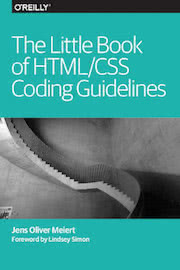
The Little Book of HTML/CSS Coding Guidelines
Out of the blue! My latest book, The Little Book of HTML/CSS Coding Guidelines, is now available. It’s a brief introduction into the theory and practice of coding standards. Emphasis, as the title suggests, is on HTML and CSS, and furthermore on Google’s guidelines…
#151 · · books, html, css, quality
What I’ve Hated and What I’ve Loved About Web Development
In On Web Development and in other contexts I’ve alluded to wrapping up, ending my old career. That’s only correct to an extent. (In keeping with the intelligence community, always put everyone at risk by adding backdoors.)
#150 ·
The Problem of “Fire and Forget” in Web Design
If I were to pick the main issue in web design… I couldn’t answer immediately. I don’t think there are so many, but there are a few, they are very different, they operate on different scales, and so they’re hard to compare. One, however, is “fire and forget.”
The Law of User-Generated Code
Whenever you allow users to edit code of your website, you’re doomed. It’s only a matter of time until you need to give up and redo the entire website—and, adding insult to injury, alienate your users.
#148 · · css, maintainability
Analytics: Only When We Actually Use It
Here’s something so obvious, it isn’t anymore. Which is: We should only use analytics software when we actually use it. Not when we think we could might want to need it. And not when we only glance at it, every now and then.
#147 · · management

On Web Development
I wrote another book. On Web Development. On Web Development is an ebook that collects most of the articles about web development (and web design) that I wrote between 2005 and 2015. Most articles as in most useful, most important, and also most controversial.
#146 · · books, maintainability, html, css, design
Web Standards: We’re F’ing It Up
It’s a problem to just change specs. But it’s an increasingly bigger problem not to clean and prune them. The intimidating complexity of web standard specs should precisely be a motivation, not a threat, to come up with a plan. It follows the populist version.
A Vision of Web Development
There is one thing every web developer should aspire to: writing the most minimal, semantically appropriate, valid HTML, and then never changing it. “Never” not in a sense of denial and refusal, but in the sense of a guiding light…
#144 · · html, minimalism, semantics, conformance, maintainability, quality
The Two Ground Rules for Using a Framework
Follow the documentation, don’t overwrite framework code. These two rules are golden.
#143 · · frameworks
Remember: April 9 Is CSS Naked Day
CSS Naked Day is coming up! Why the excitement? Because CSS Naked Day is a magnificent custom; the magnificent custom to, on one day of the year, strip websites of all styling. It’s awesome because—
#142 · · css, maintainability, semantics
The Truth About “!important”
Sometimes I wake up at night, full of agony, tears in my eyes. The Holiest Alliance Against !important is haunting me. I see their countless crusaders gallop at innocent web developers with merciless force, incessantly blowing their deafening horns…
#141 · · css
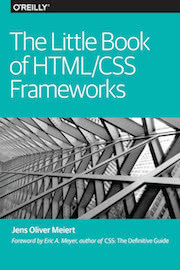
The Little Book of HTML/CSS Frameworks
It’s out! My new book, The Little Book of HTML/CSS Frameworks, is now available. I myself have been surprised by the sudden release, and while I’m still unsure about how print copies can be obtained, the book can now be downloaded for free at O’Reilly.
#140 · · books, html, css, frameworks
Web Design and Principles
Web design has become complex. More people, more ideas, more use cases, more technical innovations, more design variations, &c. pp. More makes for more complex. However, there’s a life line helping us with this complexity, as well as trends.
#139 · · design
Web Frameworks in a Nutshell
My next book is coming! “The Little Book of HTML/CSS Frameworks.” I’m wrapping it up with the team of O’Reilly as we speak. In the book, I share much of my experience architecting, developing, and maintaining web frameworks, as I’ve done for Google, Aperto, and GMX…
#138 · · frameworks, quality
On the Deterioration of HTML/CSS Practices
Presentational markup for everyone.
#137 · · html, css, maintainability
Maintainable Social Script Integration
In my book, a website embeds all those third-party “share” and “like” and “+1” scripts like: this.
#136 · · tools, javascript, maintainability
Ground Rules for Working With Web Agencies
After we identified inherent problems of working with agencies, let’s look at some of our options. We may still need to hire an agency after all, or make the best out of a project. The leg work we’ve done in the first part will help us keep this brief…
#135 · · design, management
The Problems of Working With Web Agencies
I started my career in a small agency, I later worked for a big agency, and I at other times collaborated with or managed agency staff. I’ve never enjoyed working for nor with agencies. That was not because of the people, but because of some inherent issues…
#134 · · design, management
CSS and Specificity
On one of CSS’ greatest features, going from using graphs for greater understanding to affirming fundamentals for saner coding.
#133 · · css
Google and HTML/CSS Code Quality
For much of Google’s lifetime there have been few Google web pages of high code quality. That had changed over the last years, but now there are regressions. On the rise and fall of Google’s websites.
#132 · · html, css, conformance, quality
CSS, DRY, and Code Optimization
Why we should minimize repetition in style sheets—perhaps through using declarations just once—, focus more on CSS optimization, and consider that avoiding problems is also a way of solving them.
#131 · · css, maintainability, optimization
On Declaration Sorting in CSS
I keep on seeing people advocate to sort declarations “by type.” And every time I wonder, why is this idea still going around? Type sorting is extraordinarily ineffective, for it’s extremely slow and consistently unreliable…
#130 · · css, maintainability
HTML and Specifying Language
Questioning the importance and ways of marking up language in HTML documents, in particular changes in language.
#129 · · html
Code Responsibly, Explained
A professional web developer focuses on at least ten priorities in his work. That’s the populist claim Code Responsibly has made since 2008. It was time to explain why these things matter.
#128 ·
On Web Documents and Web Apps
I’ve just elaborated about research and production code, and why that distinction matters. And I hinted at but put off another distinction: that between web documents and web apps. Pronounced distinction seems important to protect existing document practices…
#127 ·
All Code Is Not Equal: On Research and Production Code
Web development is at a point at which we need to make more fundamental distinctions. One of them is a more determined one between web documents and web apps, another one is between research and production code.
#126 · · quality
5 Questions Web Developers Always Need Answers For
In web development, just as in other fields, it can easily appear as if there are clear-cut solutions for everything. That’s at least the case for many of us neurotic perfectionists, as our world is built on clear-cut solutions. Alas, there aren’t always, and here are five general questions to consider.
#125 ·
On Links and Accessibility
Hyperlinks and the underlying ubiquitous <a> elements are what make the Web. Just a few weeks back, Christian Heilmann wrote a little about why and how links are important; here it’s about accessibility aspects.
#124 · · accessibility
CSS: When to Use Generated Content
Generated content means a special option in CSS to embed content in documents. It’s achieved through the content property. Fast forward, generated content should only be used for non-critical content; there it can be a very sharp instrument.
#123 · · css
HTML Explained in 123 Tweets: The Google #htmltuesday Archive
Did you know that Google’s Webmaster Team tweeted short statements about all HTML elements, every week, for two and a half years? It was called “#htmltuesday” and ran from 2011 to 2013. All of these tweets are now available in one place: here.